Like Urban Research on Facebook

Showing posts with label Mexico. Show all posts

Monday, March 16, 2026

Urban sprawl in Latin American cities: A historical perspective to urbanization and car ridership

 Latin American cities have experienced significant urban sprawl over the past century, characterized by the uncontrolled expansion of urban areas into peripheral zones. This phenomenon has been closely linked to socio-economic factors, car ownership, and the availability of public transportation. To understand the current landscape, it's essential to delve into the historical trajectory of urbanization in the region.​ In this video, I try to historically explain the relationship between urban sprawl in Latin American cities and socioeconomics as well as car use in 20th and 21st centuries. I will also provide some short inputs about five metropolises in Lartin America: Mexico City, Sao Paolo, Bogota, Buenos Aires, and Lima. 


Current Status of Urban Sprawl

Today, Latin American cities are among the most urbanized globally. As of 2013, approximately 80% of the region's population resided in urban areas, a significant increase from 50% in 1970. This rapid urbanization has often led to sprawling metropolitan areas with inadequate infrastructure and services.​ 

Historical Urbanization Trends in the 20th Century

Early 20th Century

In the early 1900s, Latin America was predominantly rural, with a majority engaged in agriculture. Cities like Buenos Aires, Mexico City, and São Paulo were emerging as economic centers, attracting rural migrants seeking better opportunities. However, urban growth was relatively modest during this period.​

Post-World War II Boom

The aftermath of World War II marked a turning point. Industrialization accelerated, leading to a surge in urban migration. Between 1950 and 1980, the urban population in Latin America grew from 50 million to over 200 million. Cities expanded rapidly, often without proper planning, resulting in informal settlements and inadequate infrastructure.​

Socio-Economic Factors and Urban Sprawl

Economic growth in the mid-20th century led to the expansion of the middle class, increasing demand for housing. However, limited affordable housing in central areas pushed populations toward the peripheries, contributing to sprawl. Additionally, socio-economic disparities meant that while wealthier individuals could afford centralized housing, lower-income groups settled in less accessible outskirts.​

Car Ownership and Its Impact

Rising incomes in the post-1950s made car ownership more attainable. For instance, between 1990 and 2010, per capita car ownership in Mexico more than doubled from about 75 to 175 cars per 1,000 people, and nearly tripled in Brazil from 45 to 125 cars per 1,000 people. This surge facilitated suburban living but also led to increased traffic congestion and pollution.​ 

Public Transportation Challenges

Despite urban expansion, investments in public transportation lagged. Many cities relied on informal transport systems, leading to inefficiencies. For example, in Mexico City, the metro system, inaugurated in 1969, couldn't keep pace with the city's growth, resulting in overcrowded trains and buses. By 2017, longer trips were more likely to be made by private car rather than public transit, exacerbating congestion. ​ 

Case Studies

Mexico City, Mexico

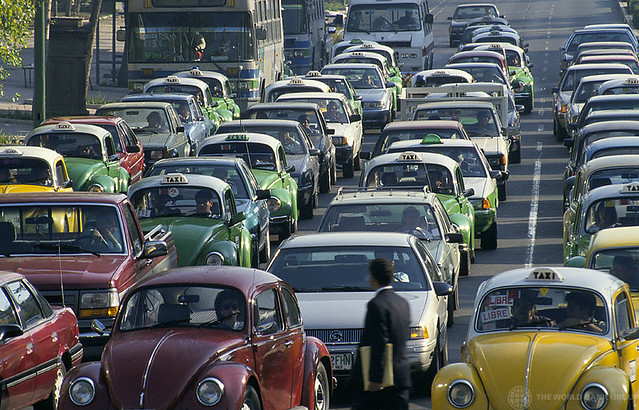
As one of the world's largest metropolises, Mexico City exemplifies urban sprawl. The city's area expanded from 1,500 km² in 1950 to over 7,800 km² by 2000. Car ownership surged, with the vehicle fleet growing by 30% between 2010 and 2018. Despite an extensive metro system, the city's public transportation has struggled to keep up with demand, leading to increased reliance on private vehicles.​ 

São Paulo, Brazil

São Paulo experienced rapid urbanization post-World War II, with its population swelling from 2.2 million in 1950 to over 12 million today. The city's car fleet grew by 22% between 2010 and 2018. Efforts to implement bus rapid transit (BRT) systems have been made, but challenges remain in reducing traffic congestion and promoting public transit use.​ 

Bogotá, Colombia

Bogotá has faced significant urban sprawl, with its population increasing from 700,000 in 1951 to over 7 million by the early 21st century. The city introduced the TransMilenio BRT system in 2000, aiming to improve public transportation. While initially successful, the system has faced challenges due to increased demand and insufficient capacity. ​ 

Buenos Aires, Argentina

Buenos Aires saw its car fleet grow from 2.4 million in 2010 to 4.2 million in 2018, a 75% increase. The city's public transportation includes buses, trains, and the Subte (subway), but the rise in car ownership has led to increased congestion and longer commute times. 

Lima, Peru

Lima's car fleet doubled from 0.9 million in 2010 to 1.8 million in 2018. The city has implemented the Metropolitano BRT system to address transportation needs, but urban sprawl continues to pose challenges for infrastructure development. 

Conclusion

The historical trajectory of urban sprawl in Latin American cities is deeply intertwined with socio-economic factors, car ownership, and public transportation development. Addressing the challenges of sprawl requires integrated urban planning, investment in efficient public transit, and policies that promote sustainable urban growth.


More about Latin America:

Bikes vs. Cars: The Urban Battle

Monday, November 18, 2024

How Public Markets Shaped Cities

Public markets have been an integral part of urban life for thousands of years, acting as the beating heart of cities around the world. From the bustling agora of ancient Greece to the vibrant Pike Place Market in Seattle, public markets have shaped how cities function and interact. Let’s dive into the story of public markets, how they evolved, and the impact they still have on our lives today.


The Origins of Public Markets: The Agora of Ancient Greece

The concept of a public market dates back to ancient civilizations, and few places exemplify this better than the Agora of Athens. Established around the 6th century BCE, the Agora was much more than a marketplace; it was the epicenter of social, economic, and political life in Athens. This large, open space was filled with stalls offering food, goods, and crafts, attracting people from all walks of life. Covering approximately 30,000 square meters, the Agora was strategically located at the city center, making it easily accessible.

In ancient Greece, the agora wasn’t merely a place to buy and sell; it was also a space for political discussion, civic engagement, and public debate. Citizens gathered here to hear speeches, engage in philosophy, and participate in democratic processes. In many ways, the agora was the birthplace of Western democracy, hosting discussions that would shape Greek society. The agora embodied the idea that a public market could be more than an economic hub—it could be the social and political heart of a community.

Medieval Markets: The Rise of Weekly Trade

As cities in Europe grew during the medieval period, public markets became central to urban development. Medieval markets generally operated on a weekly basis and were strategically located along trade routes, allowing cities to flourish as trading centers. For example, Bruges in Belgium was famous for its central market square, the Grote Markt, which became a major trading hub for merchants from across Europe. The success of markets like these helped medieval cities thrive, stimulating both population growth and economic expansion.

The Transformation of Public Markets During the Industrial Revolution

The Industrial Revolution brought rapid urbanization, changing the nature of public markets. By the 19th century, many cities had permanent indoor markets, adapting to the growing urban population. Les Halles in Paris, constructed in 1850, was one of the largest and most famous examples of this. Known as the “Belly of Paris,” Les Halles covered 20,000 square meters and supplied the city with fresh produce, meats, and fish. The market became a microcosm of Parisian life, serving everyone from street vendors to upper-class Parisians, providing not only goods but a vibrant social scene.

The Decline and Revival of Public Markets: Pike Place Market, Seattle

In the 20th century, public markets faced challenges as supermarkets, chain stores, and shopping malls took over urban retail. However, in the 1970s, cities across the world recognized the importance of preserving public markets, leading to a revival. One of the most famous examples of this is Seattle’s Pike Place Market. Opened in 1907, Pike Place Market was initially a space for farmers to sell directly to consumers, bypassing middlemen.

By the 1960s, however, Pike Place was threatened by development pressures. But thanks to public advocacy, it was preserved and revitalized. Today, Pike Place Market is one of Seattle’s top tourist attractions, drawing more than 10 million visitors annually. It’s home to hundreds of vendors, artisans, and food stalls, contributing over $250 million to Seattle’s economy each year. This revival highlights how public markets can serve as both commercial hubs and tourist destinations, revitalizing neighborhoods and enhancing community identity.

Modern Public Markets: A Global Phenomenon

Today, cities worldwide are embracing public markets for their economic and social value. La Boqueria in Barcelona, established in the 13th century, is one of Europe’s most vibrant public markets. With over 200 vendors, it attracts both locals and tourists, offering fresh produce, seafood, and tapas. La Boqueria not only supports local agriculture but also fosters a unique atmosphere that reinforces Barcelona’s identity as a cultural capital.

In Mexico City, the Mercado de la Merced is one of the largest markets in the Americas, covering over 72,000 square meters and offering thousands of different products. It serves as a crucial source of affordable food for the city’s 9 million residents and sustains thousands of jobs, showing how public markets continue to play an essential role in food security.

In Bangkok, Thailand, the Chatuchak Market spans over 35 acres and hosts more than 15,000 stalls every weekend. Attracting an estimated 200,000 visitors per day, it has become an international attraction, drawing shoppers looking for everything from local crafts to exotic foods. Chatuchak’s economic impact is immense, supporting local vendors and reinforcing Bangkok’s status as a global shopping destination.

The Role of Public Markets in Modern Urban Planning

In recent years, urban planners have recognized the importance of public markets for sustainable urban development. Public markets encourage walkability, reduce reliance on cars, and support local economies by providing spaces for small businesses. They also offer fresh food, which can improve public health, particularly in urban “food deserts,” areas lacking access to affordable, nutritious food. Cities such as Toronto and San Francisco have integrated public markets into their urban planning as a means of fostering sustainable food systems.

For example, The Ferry Building Marketplace in San Francisco, originally constructed in 1898, was transformed in 2003 into a public market emphasizing local, sustainable produce. Today, it supports over 80 local farmers and artisans, drawing millions of visitors annually. The marketplace has not only become a vital part of San Francisco’s food culture but also a model for using public markets to strengthen local food systems and reduce the city’s carbon footprint.

Conclusion: The Enduring Power of Public Markets

Public markets have endured for thousands of years because they provide more than just goods; they are social and cultural gathering spaces, economic engines, and symbols of civic pride. From the ancient agora of Athens to the bustling stalls of Pike Place Market, public markets continue to adapt to the needs of modern cities while preserving a timeless tradition of community and commerce. Today, as cities prioritize sustainability, walkability, and local economies, public markets are more important than ever.

By reconnecting us with local products, people, and cultures, public markets remind us that cities aren’t just places to live and work—they’re communities built around shared experiences and connections.

More about walkability:

Why Some Cities Feel Like a Maze

Sunday, August 6, 2017

Longitudinal correlations of car ownership with socio-economics, urban form, and transport infrastructure in Latin America: Example from Ensenada, Mexico

By Daniela Roque & Houshmand E. Masoumi

Car-orientated modal splits represent problems for the city in economic, environmental and social terms. The implementation of policies and other measures can fail if the causes are not well recognized. Mid-sized cities in Mexico are not well-represented in studies where only the capital and other bigger cities are studied. This research aims to recognize those causes focusing on northern mid-sized cities in Mexico. The approach involves numerical work (linear regression) complemented with a descriptive analysis of the city. The analysis takes on such areas of consideration as socio-economic factors, land-use variables and the street network of the city. Of the 16 variables, almost all presented a relationship with car ownership levels, but not all behaved as expected. The final part of the research is a reaction to the previous studies and recommendations to change the city from car-orientated to one with a sustainable modal split.

Read more

Ensenada, Mexico

More about urban planning in Mexico:

An Analysis of Car Ownership in Latin American Cities: a Perspective for Future Research

Wednesday, January 20, 2016

An Analysis of Car Ownership in Latin American Cities: a Perspective for Future Research

By Daniela Roque and Houshmand E. Masoumi


Car dependence must be avoided to achieve sustainable transportation; the diversity of studies available give a better perspective of the situation and how to tackle it. The reasons behind the increasing car use are still unknown in some regions such as Latin America. The gaps in the current literature are not just for location; some topics and methods are also unnecessarily predominant in the related studies. This research does a review of current literature for mobility in Latin America region with a special focus on car dependence. The aim is to detect gaps on the knowledge to further give recommendations on what should be studied. The results show the lack of numerical approaches to solidly taken case studies, especially in some countries of the region such as Central America and some of the states of South America. Disaggregate car ownership models are highly necessary for clarification of the region’s behavioral aspects of car ownership such as personal and household preferences and lifestyles. 
Read more
Traffic congestion

More papers about urban transportation planning:

Wednesday, August 19, 2015

Evaluation of Urban Sprawl Speed and Intensity Based on International Urbanization. Example from a Mexican City

By Houshmand E. MASOUMI and Daniela ROQUE

Urban sprawl characteristics and forms have been investigated thoroughly, but studies are often at a country or a region level. The related observations fail to compare sprawl in cities from different continents or cultures. This paper tries to do this by quantifying sprawl in a mid-sized city in north-western Mexico (Ensenada) between 1980 and 2014 by means of Shannon Entropy and comparing it with 12 different cities from India, Iran, Portugal, Nepal, China, and Canada. The comparisons are conducted separately targeting sprawl intensity and speed. Shannon Entropy means are compared to represent differences in sprawl intensity, while Analysis of Covariance (ANCOVA) is applied to model and compare regression coefficients that represent sprawl speed. Homogeneity of regression slopes indicates differences in sprawl speed of Ensenada with the compared cities. The results reveal that Ensenada is more sprawled than 7 out of 12 of the observed cities, but continues to spread outward with the same speed as most of the compared cities. Such international comparisons on sprawl can on the one hand give an overview of the differences in sprawl characteristics in cities around the world. On the other hand, such investigations can provide local governments, such as Ensenada, insights to shortcomings and weak points of their land use policy. Concerning the latter case, the case-study city of this research, which represents about 20 mid-sized cities of Northern Mexico, has to take urban and suburban sprawl containment policies.

Ensenada and its buffer zones between 1980
and 2014. Source: based of the data originated from IMIP

More about urban sprawl:

Applying a CA-based model to explore land-use policy scenarios to contain sprawl in Thessaloniki, Greece

Urban Sprawl Pattern Recognition Using Remote Sensing and GIS – Case Study Shiraz City, Iran

URBAN SPRAWL IN MID-SIZED CITIES OF MENA, EVIDENCE FROM YAZD AND KASHAN IN CENTRAL IRAN

A scale-adjusted measure of ‘‘Urban sprawl’’ using nighttime satellite imagery

Measurement and Monitoring of Urban Sprawl in a Rapidly Growing Region Using Entropy

The characteristics, causes and costs of urban sprawl: a lecture by Reid Ewing

A new approach to the Iranian urban planning, using neo-traditional development

URBAN SPRAWL IN IRANIAN CITIES AND ITS DIFFERENCES WITH THE WESTERN SPRAWL

Friday, January 20, 2012

Bike sharing around the world

By Suemedha Sood

Bike sharing is a fun, easy, environmentally friendly way to explore a new place. Here are eight cities with great 24-hour bike sharing programs that travellers should know about. 

Paris
Although community bicycle sharing has been around since at least the 1960s, Paris’s Vélib’ became the first high-profile program to spark global interested in organized bike sharing when it launched to great success in 2007. The program currently has about 20,000 bikes and 1,800 bike stations (one located every 300 metres), yielding about 50 million unique rides annually.
The details: Vélib’ required subscriptions are available for 1.70 euros per day, 8 euros per week, or 29 euros per year. Once you’ve subscribed, half-hour rides are free but each additional half-hour costs 1 euro for up to one-and-a-half hours. After that, each additional half-hour costs 2 euros.

Bike sharing in Paris, photo by sujal
Hangzhou, China
With more than 50,000 bikes and 2,050 bike stations, the Chinese city of Hangzhou is home to the world’s largest bike sharing program. Bike sharing is well integrated with other forms of public transport, with bike stations available near bus and water taxi stops.


Bike sharing, photo by infomatique

more about bike sharing:

The Case for Bike-Share

Tehran's "Bike House" Shines Green

sustainable transport

World’s largest bike-share system in China dwarfs popular U.S. program

City of Boston Announces Its BIXI Bike Share Program Is a Go

Urban Bike Sharing System Coming to London!

Bike Share: A slice of Paris in Chicago

Metroradruhr: Germany's Ruhr Valley Inter-City Bike Sharing

Wednesday, December 28, 2011

Hopeful Footsteps in Mexico City’s Centro Histórico

by Ruth Samuelson

After years of steady deterioration, Mexico City’s Centro Histórico is finally showing signs of health.
Public and private efforts, especially by Mexican billionaire Carlos Slim Helú, have bulked up security, refurbished old parks and gathering spots and increased economic development in the area. But the renaissance’s defining feature is obvious: it’s the ground.
In recent years, the Centro has closed off three streets to vehicular traffic and has plans to convert more. Known for its museums, landmarks and busy markets, the area is now drawing more youthful crowds, thanks in part to shopping and nightlife on its pedestrian streets.
The street closure treatment has also deterred crime, according to local business owners. One of the zone’s biggest problems is residential vacancies. While Centro’s always bustling by day, it’s still desolate after dark in many spots.
The first walkway, Regina street, was inaugurated in 2008. Dubbed a "Cultural Pedestrian Corridor" by the government, it’s loaded with hip, laidback restaurants and mezcalerias.

Centro Histórico, photo by luigig
Centro Histórico, photo by teachandlearn


more about urban Mexico:

Mexico’s Proposed 2012 Budget Fails to Allocate Adequate Funding for Climate Change

Cycling in Mexico City, Aggressive Driving, Integrated Mobility Sharing

A modern-day ghost town A rural Mexican community is almost empty

THE URBAN SPRAWL: A PLANETARY GROWTH PROCESS? AN OVERVIEW OF USA, MEXICO AND SPAIN

MEXICO: Capital Badly in Need of Urban Regeneration

Sunday, December 4, 2011

Mexico’s Proposed 2012 Budget Fails to Allocate Adequate Funding for Climate Change


According to a new study by the Mexican Finance Group – 16 NGOs, including CEMDA, that work on environmental, budget, gender equity, and human rights issues – the funding currently allocated in Mexico’s budget for climate change mitigation and adaptation is insufficient for meeting the goals the country has established for 2012. The group, created in 2010, agrees that international finance is necessary to complement domestic investment in order to achieve Mexico’s emissions targets, but they affirm that first and foremost it is necessary improve the national budget allocation to begin the transition towards a low carbon development path.

Mexico’s Mitigation Goals and the National Budget

In accordance with the goals established in the Special Program on Climate Change (PECC, per its acronym in Spanish), Mexico will reduce its GHG emissions by 51 million megatons CO2-equivalent from 2000 levels by 2012. Of that amount, 36% of the reduction is expected to come from the energy sector; 30% from agriculture, forests, and other land uses; and 23% from the transport sector. The Secretary of Environment and Natural Resources (SEMARNAT) has recognized that Mexico is behind in meeting these reduction targets. To reverse this, budgetary funds must be redirected in a transparent and equitable manner that allows Mexico to move towards a truly low-carbon economy.
To arrange such reallocations of funds, and at the request of several concerned members of Mexico’s Congress, CEMDA and our partners conducted an analysis of budget allocations in Mexico’s four major carbon-emitting sectors (transportation, energy, agriculture, and forestry). We found a disturbing decline in resources allocated to mitigation and adaptation in the 2012 budget proposal: These resources dropped from 584.2 million pesos in 2011 to 221.1 million pesos in the 2012 budget, a 62% reduction.

Energy

Mexico’s energy sector contributes 21% of the country’s GHG emissions. Investment in renewables and energy efficiency is fundamental to reducing those emissions. However, our analysis found that the government continues to prioritize fossil fuels and to promote the research and expansion of nuclear energy. It also found that energy sector subsidies – which primarily target fossil fuels – are rising; they will reach almost 84 billion pesos by 2012.

read more

Air pollution in Mexico City, photo by Malingering

more about climate change:

Cycling in Mexico City, Aggressive Driving, Integrated Mobility Sharing

Becoming Greenest: Recommendations for a More Sustainable Washington, D.C.

Urban Sprawl Could Make Cities Hotter

SUSTAINABLE URBAN ENERGY PLANNING: A STRATEGIC APPROACH TO MEETING CLIMATE AND ENERGY GOALS

Sunday, October 30, 2011

Cycling in Mexico City, Aggressive Driving, Integrated Mobility Sharing


Lima’s Metropolitano BRT system celebrated its 100 millionth passenger this week. At the end of 2010, the BRT system was carrying an average of 220,000 passengers daily. Today, the daily passenger rate is at 360,000 individuals. The goal for December 2011 is to transport half a million passenger per day.
Mexico City is seeing a rise in bicycle use among its middle and upper classes, according to news from USA Today. Local cycling initiatives started in 2006 in Mexico City under the leadership of Mayor Marcelo Ebrard. Since then, cycling has become a fashionable transport mode. The local environment secretariat estimates that there are 100,000 cycling trips made daily in the city.
U.S. Transportation Secretary Ray LaHood announced a $75 million federal funding to improve the oldest and slowest active commuter rail line in the Massachusetts Bay Transportation Authority. The funding is estimated to bring employment opportunities to 260 people.

Urban Development + Accessibility
Real estate agents in Cape Town, South Africa report that the implementation of MyCiTi Bus Rapid Transport system in the city’s West Coast corridor has had a positive impact on the property market. The efficiency of the public transport system halved the time properties remain on the market.
Mayor Bloomberg announced a $20 million gift to the city’s famous High Line park from the Diller-von Furstenberg Family Foundation. Previously, the High Line needed $85 million to finish the design and implementation of the park and maintain it for three million visitors every year.
Michigan Gov. Rick Snyder is calling on state legislature to approve a proposal that would allow local municipalities to raise vehicle licensing fees to a rate between $40 and $120. The raised rates would bring in between $300 million and $1 billion for infrastructure and transit projects in Michigan.


similar posts:

16-Mile Bike Lane Connects Detroit Neighborhoods

Road hogs: Minneapolis cyclists don’t need to share

Bike Shares Struggle To Work With Helmet Laws

BICYCLE DEVELOPMENT PLAN- City of Peoria, Arizona 

Wednesday, October 26, 2011

A modern-day ghost town A rural Mexican community is almost empty

A modern-day ghost town A rural Mexican community is almost empty. Its people are chasing prosperity from their cramped quarters in Rolling Meadows.(Series: Exodus from Mexico)(News)

by Korecki, Natasha

Just miles from other pueblos, where dirt roads slop with mud after a rain, water drips into living rooms and bedsheets hang over open doorways, this tiny, seemingly scrubbed-clean town peeks out brightly.
In Quiringuicharo (key-ding-gwi-CHARO), two-story houses wear fresh coats of paint.
But few cars move through the well-paved streets. No chit-chat can be heard from the shops. No food vendors ply their trade.
The refurbished town square sits empty; no children run playfully down its walkways.
A cross atop a hill can be lighted, but no one has turned it on for months. 


similar posts:

Toronto’s Genius Project: Evergreen Brickworks

Abandoned residential units in Dessau, Germany

Gentrification before Gentrification? The Plight of Pilsen in Chicago

Sunday, February 20, 2011

THE URBAN SPRAWL: A PLANETARY GROWTH PROCESS? AN OVERVIEW OF USA, MEXICO AND SPAIN

by Blanca Arellano and Josep Roca

It is a fact that the urban sprawl, known as the process of gradual spread out of urbanization has become a worldwide phenomenon. The growing consumption of land, as a result of the extension of highway networks, open up vast space of territory, which seems to have become an unstoppable cancer, and affects virtually all the contemporary metropolis.
The expansion of the cities had its origin in the model of suburban life, which began with the generalized use of the automobile. A lifestyle based on the "american dream‖, one single family-home, one (or more) car (s)." But it has been since late 70’s of the last century, when it has had a more dramatic development, as a consequence of the crisis of metropolitan areas linked to what, it is called Post-Fordism economy and some authors have characterized as counter-urbanization (Berry) desurbanization (Berg), edge-cities (Garreau) metapolis (Asher) or diffuse city (Indovina). Despite the diversity of urban development, the increasing consumption of land, the excessive use of land as a scarce resource, it is a constant in the urbanization process in the early twenty-first century.
The object of our contribution is to make an overwiew about urban sprawl in USA, Mexico and Spain. The use of technologies related to satellite imagery (remote sensing) allow the characterization of the phenomenon of consumption, pathological or not, of land. And this analysis suggests some hypothesis about the plurality of the contemporary urbanization processes. Roughly two models stand out: On one hand, urban development based on low densities, where the unsustainable consumption of land is presented as a paradigm of economic development and, on the other hand, an urban development with a compact city model, where recycling land, and not just increasing the consumption of land, is one of the key objectives of urban policies. The work presented here, suggests that in the second model seems to appear a change in the paradigm towards a more efficient and sustainable use of the territory.


Las Palmas in Spain, photo by WindwalkerNld
more about Spain:

Skyline photos of Madrid 2

Routes of Gothic

Toward Low Carbon Cities: Madrid and London

Thursday, February 17, 2011

MEXICO: Capital Badly in Need of Urban Regeneration

By Emilio Godoy 

Is urban regeneration feasible in Mexico’s capital city? This is a question asked by planning experts and by a large proportion of the city’s population. Some projects currently underway indicate that the answer could be yes.
Ecological architectural design, green rooftops, vertical gardens and the principles of permaculture (management of land, water, energy and human settlements based on natural interrelations) are the foun ation of a new kind of development that aims to make urban spaces more habitable, friendly and sustainable. "Regeneration is possible. We have a lot of areas in our city where we can restore the soil and the environment and connect them with human activities," Elías Cattan, head of Taller 13, a regenerative architecture firm, told IPS.
Urban regeneration involves environmental, physical, urban, social and economic aspects, and proposes alternative designs to improve quality of life for people in a district or entire city. Founded in 2001, Taller 13, together with the architecture department of the private Ibero-American University (UIA) in Mexico City and the Regenesis Group in the U.S., offers workshops to promote this design approach, which has gathered momentum over the last decade.
"It will be neither an easy nor a small-scale undertaking, but I do think it is viable," José Antonio Flores, founder and head of the non-governmental organisation (NGO) Efecto Verde (Green Effect), told IPS. 


A regenerated district in Mexico City, photo by Gary Denness

 more about Mecixo:

SUSTAINABLE TRANSPORT PLANNING: A METHODOLOGICAL APPROACH