Like Urban Research on Facebook

Showing posts with label Ecocity. Show all posts

Tuesday, February 12, 2013

Sustainable Urban Development and the Chinese Eco-City: Concepts, Strategies, Policies and Assessments

by May Hald

The need for sustainable urban planning and development reached an important point in 2007, when half of the world’s population was defined as living in cities. This need is especially true for a country like China, where an unprecedented urban-rural migration has been taking place since 1978. Such a mass movement has posed many sustainability challenges for Chinese cities; for example, China is home to 16 of the 20 most polluted cities in the world. Now China’s leaders are attempting to use the country’s transition to a market economy and integration into the global economy to advance environmental and social issues, also on an urban level. One way the country is confronting urban growth and sustainability challenges is through an eco-city development approach. The eco-city concept is relatively new in China, and is being used in cities such as Tianjin and Dongtan near Shanghai. Whether eco-cities address the main problems associated with urban development and sustainability, however, rests on a broader, more fundamental planning approach that would streamline the goals and priorities of a large number of stakeholders, focus on existing city problems and look at small-scale eco- initiatives for answers, and thus remains in question.


photos of Rizhao, China:

Rizhao_10252012_001 IMGP5766-DCF
more about urban China:

China’s Hangzhou Public Bicycle: Understanding Early Adoption and Behavioral Response to Bikesharing

Chinese bike-sharing dwarfs US and European programs

The Unsquared Circle of Old Shanghai

SOM wins Beijing Bohai Innovation City Master Plan Competition

Can Chongqing's Urbanization Survive China's Shrinking Workforce?

Emergy synthesis for the urban ecosystem health of four municipalities in China

A Chinese eco-city: City of dreams, Still on the drawing-board

Friday, June 22, 2012

Tackling Urban Sprawl: New Urbanism and Eco-Towns

By Bruce Stutz

Can eco-towns stop the sprawling suburbs? Urban sprawl is a modern phenomenon most prominent in the United States and spreading into parts of Europe, it has many consequences which include the rising carbon emissions from modern consuming habits such private car use.
This article is a selection of excerpts from two recent articles by Bruce Stutz ‘The New Urbanists: Tackling Europe’s Sprawl’ and ‘Britain’s Elusive Eco-Town Dream’. Stutz analyses the debate surrounding ‘eco-town’ developments which many regard as practical solutions for a carfree and carbon-free future, as well as the principles of New Urbanism which are gaining in popularity for urban development.

The Super Sprawl

In the last few decades, urban sprawl, once regarded as largely a US phenomenon, has spread across Europe. Improved transport links – highways designed to accommodate increased freight traffic – have led to American-style intercity corridors built up with new industrial and commercial developments. Auto-centric suburbs with low-density housing tracts and shopping malls have followed, and public transit has not been able to keep pace. Now an emerging group of planners are promoting a new kind of development – mixed-use, low-carbon communities which are pedestrian-friendly and mass-transit-oriented.
A nearly iconic fact of life in the US, urban sprawl had been slow to evolve in Europe. Cities from Luxembourg to Prague, from Madrid to Istanbul, are experiencing accelerating sprawl and its increased automobile traffic, carbon dioxide (CO2) emissions, energy consumption, land fragmentation, natural resource degradation, watershed damage, farmland decline, and social polarisation –has become a major concern across the continent. Over the last 20 years, the number of kilometres travelled in urban areas will increase 40%, an increase that will negate any expected gains in fuel efficiency, and make reaching Europe’s Kyoto goals of reducing CO2 emissions nearly impossible. In the newest EU countries, those in Eastern Europe that had been communist, the changes have been even drastic. Central planning demanded high-density housing and public transit. With its entry into the EU in 2007, Romania’s economy grew 5.7%, and the year after, 7.5%. This economic development drove residential construction up 29.3% in 2007, and along with it, the number of cars – up 27%.

Enter New Urbanists

For the new urbanists, building an eco-town is not a matter of building ‘green’ buildings. More important is creating places that encourage people to change their unsustainable behaviours and then enable them to do it. New urbanism arose in the 1980s in reaction to the planning and design practices of the preceding decades. 

read more

Urban_sprawl  
more about urban sprawl:

Detroit's prospects may be better than we think

Land use change modelling in an urban region with simultaneous population growth and shrinkage including planning and governance feedbacks

Documentary film: Sprawling from Grace: The Consequences of Suburbanization

Municipal Finance and the Pattern of Urban Growth

Suitability criteria for measures of urban sprawl

On defining "Sprawl"

Cleanliness from a car

SHRINKING CITIES—Growing Domain for Urban Planning?

PRESERVING COST-EFFICIENT INFRASTRUCTURE SUPPLY IN SHRINKING CITIES

Thursday, April 19, 2012

The eco-city: ten key transport and planning dimensions for sustainable city development


Making existing cities and new urban development more ecologically based and liveable is an urgent priority in the global push for sustainability. This paper discusses ten critical responses to this issue and summarizes them in a simple conceptual model that places the nexus between transport and urban form at the heart of developing an eco-city. This involves compact, mixed-use urban form, well-defined higher-density, human-oriented centres, priority to the development of superior public transport systems and conditions for non-motorized modes, with minimal road capacity increases, and protection of the city’s natural areas and food-producing capacity. These factors form the framework in which everything else is embedded and must operate, and if they are not addressed only marginal changes in urban sustainability can be made. Within this framework, environmental technologies need to be extensively applied. Economic growth needs to emphasize creativity and innovation and to strengthen the environmental, social and cultural amenities of the city. The public realm throughout the city needs to be of a high quality, and sustainable urban design principles need to be applied in all urban development. All these dimensions need to operate within two key processes involving vision-oriented and reformist thinking and a strong, community-oriented, democratic sustainability framework for decision-making.


more about sustainable transportation:

Measuring Perceived Accessibility to Urban Green Space: An Integration of GIS and Participatory Map

Los Angeles Streetcars: A Push To Bring Back The Rich History Of Streetcars Begins In Downtown LA

Urban form and the ecological footprint of commuting. The case of Barcelona

New German community models car-free living

Paris to Allow Cyclists to Run Red Lights

Metroradruhr: Germany's Ruhr Valley Inter-City Bike Sharing

Bike Share: A slice of Paris in Chicago

Monday, April 16, 2012

Tackling eco-urbanity: Housing and placemaking at the urban edge

by A.Senem DEVİREN

With more than half of the world population is now living in urban settlements, urban growth is almost inevitable. But our cities are not growing in healthier and ecological ways, they are ‘sprawling’. Much of this sprawl is a result of new housing developments and constructions for their related services, occurring rapidly one after the other at urban peripheries. There are several principles and guidelines offered for ‘ecologic’ urban planning and ‘eco’ or ‘green’ building design. However, most of these guidelines are rigid, contemporary market-driven and global ‘checklists’ with no ability to inform local urban design and interdisciplinary practice and polarizing the differences in design disciplines with their incompetent content that is far from addressing the symbolically, ecologically and functionally powered interrelations between built environments and nature. This paper addresses ecological housing design and planning at urban edges by proposing an updated urban design strategy –the placemaking strategy- and testing its role in monitoring eco-urban development with actual case studies on two ecological settlements at the urban edge of Linz, Austria. The study investigates and highlights the importance of architecture and landscape combined comprehensive urban design strategy to preserve land, prevent consumption in all terms, to utilize the on-site resources, and use of renewable energy sources, to improve functional and social performance of urban contexts at urban edges and maintain healthy living conditions for the inhabitants for longer term goals of livability and sustainability.


more about sustainable city:

MESSAGE FROM TRADITIONAL SETTLEMENTS FOR FUTURE CITIES

Strategy for Sustainable Urban Development: A Case Study of Urmia City, Iran

German Village Becomes Model for Renewable Energy

SOM wins Beijing Bohai Innovation City Master Plan Competition

Lessons from Freiburg on Creating a Sustainable Urban Community

The Münster Application for the European Green Capital Award

Sunday, April 15, 2012

MESSAGE FROM TRADITIONAL SETTLEMENTS FOR FUTURE CITIES

by S. Ecemis Kilic

The concepts of “liveable city” or “sustainable city” are used widely for describing what the expectation of the future cities is. The concepts have some common objectives and refer to human oriented, environmentally friendly, economically efficient and socially sound, urban areas. When different traditional urban fabrics in Turkey have analyzed, it is seen that they  are  successful with  respect  to  sustainable  /liveable  urban  design  parameters  although they were not designed by a designer or planner.  The paper aimed to attain some principles for the more liveable future cities from the traditional urban forms and to find instruments for  transferring them in today’s planning and design theories and practices.


more about urban Turkey:

Urban Reforms of Tanzimat: Early Urbanization and Transportation Practices in The Formation Process of Turkish Reconstruction System (1839-1908) in Bursa The First Capital City of Ottoman Empire

UNDERSTANDING URBAN GROWTH PATTERNS: A LANDSCAPE ECOLOGY POINT OF VIEW

De-spatialized Space as Neoliberal Utopia: Gentrified İstiklal Street and Commercialized Urban Spaces

Accessibility effect on urban land values

APPLICATION OF THE URBAN REALMS MODEL TO ISTANBUL

Tuesday, February 21, 2012

Sustainable Urban Forms Their Typologies, Models, and Concepts

by Yosef Rafeq Jabareen

This article identifies sustainable urban forms and their design concepts. In addition, it addresses the question of whether certain urban forms contribute more than others to sustainability. A thematic analysis has been used to coop with the vast body of sustainable development and environmental planning literature. The analysis identifies seven design concepts elated to sustainable urban forms: compactness, sustainable transport, density, mixed land uses, diversity, passive solar design, and greening. Moreover, it identifies four types of sustainable urban forms: the neotraditional development, the urban containment, the compact city, and the eco-city. Finally, this article proposes a Matrix of Sustainable Urban Form to help planners in assessing the contribution of different urban forms to sustainability.


more about urban form:

TRANSFORMING AUTO-CENTRIC COMMUNITIES INTO WALKABLE NEIGHBORHOODS: WALKABILITY AUDITS OF TWO NEIGHBORHOODS IN SAN JOSÉ

Accessibility Measures: Overview and Practical Applications

Is Detroit the new Brooklyn?

The Middle Eastern Islamic City: Type and Morphology

Sustainability: A Vital Concept for Transportation Planning and Development

Friday, January 20, 2012

Lessons from Freiburg on Creating a Sustainable Urban Community

by Joseph Little

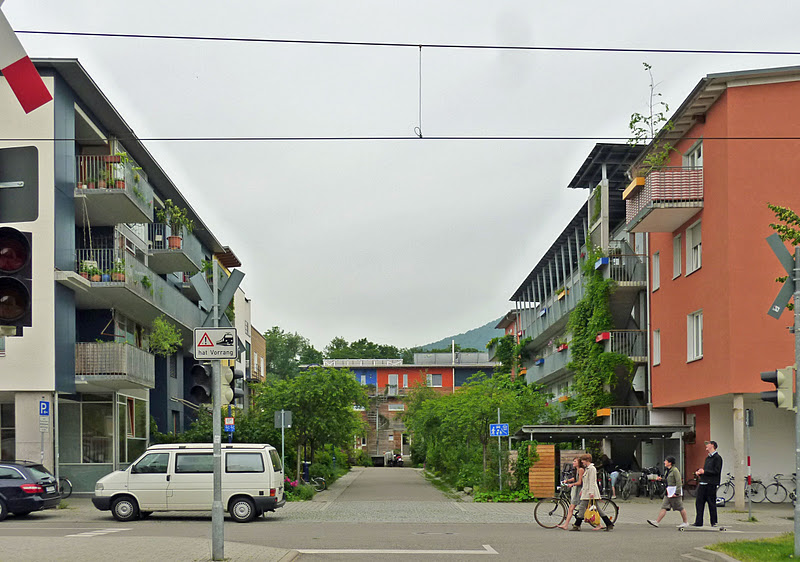
The development comprises 2,000 homes plus business units for 500 - 600 jobs. If all proceeded to programme it was completed in 2006. Excluding the remaining barracks buildings (shown in white to the right of the site) which were renovated and turned into student accommodation, an asylum seekers’ centre and the Forum-Vauban offices, the site was to be developed in three phases. From an early stage it was agreed that the primary goals for Vauban were:
1. To offer high quality building spaces for young families within the city's limits and to counteract urban sprawl.
2. A dense urban design concept comprising low energy standard for all buildings, green spaces, good public access (including a new tram) and further infrastructure (kindergartens and a primary school). Further objectives were developed during the participation process organized by Forum-Vauban. The most important were:
Vauban, Freiburg, Germany, photo by sararasmussen

3. The car-free project combined with the specific traffic concept and the special offer of alternative mobility,
4. Promotion and support of Baugruppen
5. A minimum of 100 buildings built to Passiv Haus Standard,
6. A central market place and a community center.
7. The Forum's priority was to develop a sustainable city district in aparticipatory way which could become a model for further initiatives.


Vauban, Freiburg, Germany, photo by Jute Marketing

Vauban, Freiburg, Germany, photo by Payton Chung

Vauban, Freiburg, Germany, photo by Jute Marketing
Vauban, Freiburg, Germany, photo by tom.brehm

Vauban, Freiburg, Germany, photo by bjoern.f | Björn Freiberg Fotografie

Vauban, Freiburg, Germany, photo by Payton Chung

Vauban, Freiburg, Germany, photo by tom.brehm

more about green design:

A Seattle development that is greener than green

A house with no furnace? You betcha

Sustainability on the Urban Scale: ‘Green Urbanism’

The Human Benefits of Green Building

The relationship of historic city form and contemporary greenway implementation: a comparison of Milwaukee, Wisconsin (USA) and Ottawa, Ontario (Canada)

New Heden: The City Made of Green Roofs

The Vauban district is a green, planned community in the city of Freiburg in southern Germany. Construction of this community began in the mid-1990s and opened in 2000. By 2001, it had 2,000 inhabitants living in a greener, more sustainable way. Now, the Vauban district is said to have 5,000 inhabitants and 600 jobs. A recently article I ran across highlights the green features of this community and I thought I’d share some of that here.

Sunday, December 11, 2011

Sustainability on the Urban Scale: ‘Green Urbanism’

by Steffen Lehmann

Among the most significant environmental challenges of our time are global climate change, excessive fossil fuel dependency and the growing demand for energy – all likely to be major challenges of the 21st century and one of the greatest problems facing humanity. In this context, urban design and the fundamental principles of how to shape our cities has barely featured in the greenhouse debate. Much of the debate in related areas has so far circled around ideas about active technology for ‘eco-buildings’. This is surprising, since almost half the energy consumed is used in cities and urban built-up areas, and given that avoiding mistakes in urban design at early stages could genuinely lead to more sustainable cities and less greenhouse gas emission. This paper reflects upon practical strategies focused on increasing sustainability beyond and within the scope of individual buildings. The paper deals with cross-cutting issues in architecture and urban design and addresses the question of how we can best cohesively integrate all aspects of energy systems, transport systems, waste and water management, passive and active strategies, climatisation and so on, into contemporary urban design and improved environmental performance of our cities. It provides a context for a general debate about the regeneration of the city centre, and discusses how urbanism is affected (and can be expected to be even more affected in future) by the paradigms of ecology. The significance of the research is found in the pressing need for an integration of sustainability principles in the urban design process of cities in South East Asia and the general need for a sustainable city development. It will be of particular relevance to the rapid urban growth of developing cities that have, in the past, frequently been poorly managed. Research in sustainable urban design recommends increased harnessing of the energies manifested in the existing fabrics – for instance, through the adaptive re-use of former industrial (brownfield) sites and the upgrade and extension of existing building structures. It is less environmentally damaging to stimulate growth within the established city centre rather than sprawling into new, formerly unbuilt areas. Two recent examples for the application of such urban design principles are the author’s proposals for the Australian city of Newcastle: the ‘City Campus’ and ‘Port City’ projects.


Similar posts:

The eco-city: ten key transport and planning dimensions for sustainable city development

BENEFITING FROM GLOBALISATION: TRANSPORT SECTOR CONTRIBUTION AND POLICY CHALLENGES

Sustainable Urban Planning

Strategic Urban Planning and Design Tools for Inner City Regeneration: Towards a Strategic Approach of Sustainable Urban Form Future The Case of Bandung City, Indonesia

How the Imagery of "Urbanized" Motivates Better Places

The eco-city: ten key transport and planning dimensions for sustainable city development

by JEFFREY R KENWORTHY

Making existing cities and new urban development more ecologically based and liveable is an urgent priority in the global push for sustainability. This paper discusses ten critical responses to this issue and summarizes them in a simple conceptual model that places the nexus between transport and urban form at the heart of developing an eco-city. This involves compact, mixed-use urban form, well-defined higher-density, human-oriented centres, priority to the development of superior public transport systems and conditions for non-motorized modes, with minimal road capacity increases, and protection of the city’s natural areas and food-producing capacity. These factors form the framework in which everything else is embedded and must operate, and if they are not addressed only marginal changes in urban sustainability can be made. Within this framework, environmental technologies need to be extensively applied. Economic growth needs to emphasize creativity and innovation and to strengthen the environmental, social and cultural amenities of the city. The public realm throughout the city needs to be of a high quality, and sustainable urban design principles need to be applied in all urban development. All these dimensions need to operate within two key processes involving vision-oriented and reformist thinking and a strong, community-oriented, democratic sustainability framework for decision-making.


similar posts:

Architecture, Urban Planning and Biodiversity: Thoughts about an ecopolis, Plea for a lobe city

Urban Development To Combat Climate Change: Dongtan Eco-city and Risk Management Strategies

A Chinese eco-city: City of dreams, Still on the drawing-board

Toward Low Carbon Cities: Madrid and London

Sunday, March 20, 2011

Architecture, Urban Planning and Biodiversity: Thoughts about an ecopolis, Plea for a lobe city

by Erik ROMBAUT

Towns are generally regarded as the cause of many ecological and social problems. Can they, in the future, also become the source of solutions? If so, what is the best strategy and the best urban model for achieving these goals?
This paper presents a number of eloquent and inspiring examples of ecological residential neighbourhoods and green industrial parks in European cities.
The creation of a “semi-public common interior space” in residential neighbourhoods (through a judicious dosage of the public and the private) seems to be the town planning key and strategy for solving both ecological and social problems. There is no doubt that when these interior spaces are inter-connected to form a blue and green network with the right ecological conditions, a surprisingly
high biodiversity can be preserved in an urban environment. Whether or not such an approach will strengthen the social diversity in towns depends, among other things, on the extent to which one resists the tendency to close these semi-public environments (that is, to privatise them) and to transform them into an urban eco-ghetto.
To conserve urban biodiversity, the “lobe-city” seems to offer the best prospects. This was developed as an urban model in the first half of the 20th century, in most cases as a reaction to the concentric growth of towns that was regarded as suffocating (GIELING,2006). It is characterised by blue and green fingers (wedges) in which one can find countryside-features penetrating deep into the “lobe-city”. Among others, the expansion plan for Cologne/Köln (1927) in Germany and the “finger plan” for Copenhagen (1948) in Denmark were based on this concept. To varying degrees, the model of the “lobe-city” was also employed in the general plan to extend Amsterdam (NL-Amsterdam Uitbreidings Plan AUP, 1935) and in cities as Hamburg, Berlin, Freiburg im Breisgau, Frankfurt am Main (D)and Stockholm (S).
I will focus on the theme ‘ecological sound urban water management’. That means that other very important topics, such as waste management, traffic management and of course energy management will not be tackled here. For details about these topics in relation to the lobe city theory, we refer to ROMBAUT.


Central Copenhagen, by felissy

more about Copenhagen:

Creative Copenhagen: Globalization, Urban Governance and Social Change

Copenhagen – city of cyclists!

Complete Streets Lessons from Copenhagen

Tuesday, March 15, 2011

Urban Development To Combat Climate Change: Dongtan Eco-city and Risk Management Strategies

by Peter R. Head  and J. Gary Lawrence

The activities of urban settlements are key contributors to climate change factors. In parallel, global climate change and its current and potential consequences for life property and prosperity is now accepted as the major challenge for human society in the next 100 years. The translation of science into policy and practice that stems the acceleration of greenhouse gas production, particularly carbon, while also ensuring social and economic development is still in its infancy. Drawing on lessons learned from the planning and development of a new, low-carbon eco-city on an island opposite Shanghai in China, this paper explores the potential of an integrated urbanism approach. The objective being not only to mitigate factors contributing to climate change, but to manage risk, maximize resilience, and promote the successful economic and social growth of the urban community. We posit that no matter what the scale, integrated approaches – both in understanding the true nature of the issues and designing solutions – are predictive or more successful outcomes. Global populations are growing creating stress on existing resources; sprawl consumes natural buffers making metro areas more vulnerable; distributed governance responsibility confounds coordinated planning; a successful global economy is dependent on the resilience of public infrastructure and the metropolitan labor market. An integrated urbanism approach to planning may give us the tools to leapfrog the environmental and public health costs of economic progress and create a new model for cities across the developing world.


Dongtan, Shanghai, by Tourist Republic

more on eco-city:

Toward Low Carbon Cities: Madrid and London

Eco building idea from Alexander Remizov

A Chinese eco-city: City of dreams, Still on the drawing-board

A Chinese eco-city: City of dreams, Still on the drawing-board


IDEAS about tackling China’s myriad environmental woes, from soil erosion to polluted waterways, tend to come in outsize packages—hardly surprising, given the scale of the damage. Bold environmental solutions are as appealing to policymakers as they are to engineers who want to put their stamp on the cities of tomorrow. One such project is Dongtan, a planned eco-city on an alluvial island near Shanghai. Designed by Arup, a British design firm, to house 500,000 people on a 8,600-hectare (21,250-acre) site, it was billed as a low-carbon alternative to urban sprawl and a blueprint for other eco-cities. But four years on, not a single green building has gone up on the site.
The reason lies not in the spluttering global economy but in the political corridors of Shanghai, the powerful city to which Chongming island belongs. A prime mover behind Dongtan was a former Shanghai Communist Party chief, Chen Liangyu, who steered the land into the hands of Shanghai Industrial Investment Corporation, or SIIC, a state-owned developer, and lent his prestige to the project. Then, in 2006, Mr Chen was sacked for property-related corruption. He was later convicted and is under house arrest. The way big land deals are done in Shanghai has been changed. 


Dongtan eco-city, by Tourist Republic

more posts about eco-city:

Eco building idea from Alexander Remizov

Toward Low Carbon Cities: Madrid and London

Friday, March 4, 2011

Eco building idea from Alexander Remizov

via Ideas for Houses

The Russian visionary Alexander Remizov thought that we have to change the way we interact with nature in order to create a comfortable habitat.
Alexander Remizov also had in mind that nature, following it’s natural course, will not offer us the best premises for a comfortable environment. The solution would be to change the nature for our benefit? Or maybe we could change our needs and our way of life according to nature’s course?
The Russian architect decided to build a house, better said a dome, that fits to our second solution. “The ark”, as he named it, is a eco-friendly mega structure that can be built quickly either on land or sea.


more green design posts:

Friday, December 31, 2010

Toward Low Carbon Cities: Madrid and London

Judith Ryser and Teresa Franchini, Toward Low Carbon Cities: Madrid and London
45th ISOCARP Congress 2009

Why choose Madrid and London to discuss low carbon cities?
Madrid and London are both big cities for European conditions. Their metropolitan character, building stock, airports and motorway networks, and status as international hubs add considerably to their ecological footprint. If they manage to curb their CO2 emissions they will have a noticeable impact on climate change.
Could Madrid and London become low carbon cities?
Spain and the UK have set stringent targets to reduce CO2 emissions and have taken concrete actions to implement them. They have allocated fundsi, introduced changes to their own building and rolling stock and pledged to reduce their own wasteful energy use. Their campaigns have raised awareness among citizens and businesses to change their behaviour toward energy consumption,iii and they have launched actions to mitigate and adapt to climate change in all key sectors.iv Madrid and London have adopted similar targets and measures. Will they suffice though to transform them into genuine low carbon cities or ‘eco-cities’ in the long term.
 
1. The Critical Path toward ‘Eco-Cities’
 
In answer to the questions of this paper, it is necessary to define first what is meant by ‘low carbon’ or ‘zero carbon’ city or, more generally, by an ‘eco-city’.
 
1.1 Defining Eco-Cities

What is an ‘eco-city’ and where does the notion come from? Early settlements in Mesopotamiavi may be their precursors as they serve the collective needs of their communities with local natural, renewable materials. Such vernacular architecturevii remains an inspiration for ‘eco-design’.viii Is living in sustainable symbiosis with nature feasible in an urbanised world? In the developed world, Jane Jacobsix considered that cities which are integrated with their immediate hinterland are drivers of prosperity and capable of revitalising nature in overloaded rural areas. The American eco-city movement proposed alternative solutions for city planning.x Richard Registerxi coined the term ecocity in 1987. His ‘Ecocity Builders’xii defined an ecocity as ecologically healthy: “an ecocity is a human settlement that enables its residents to live a good quality of life while using minimal natural resources”. They perceive Paolo Soleri’s Arcosanti in Arizona as the prototype of such an ideal ecocity. The European Union ecocity project on “urban development towards appropriate structures for sustainable transport” incorporated the sustainability visions of the participant cities, while the ecological cities movement produced international manifestos.The ecocity concept is gathering momentum in the developing world. For Akhtar Chauhanxiv a sustainable living environment is “based on climate responsiveness, appropriate use of technologies, and innovation of sustainable environmental design”. China is committed to realising ecocities, the most publicised among them Dongtan in the Shanghai conurbation and Tianjin ecocity, planned in cooperation with Singapore on a salt pan near China’s third largest city. Curitiba is Brazil’s avant-garde ecological capital with its ecological public transport system and university of the environment. Porto Allegre follows participatory ecoprinciples from the bottom up. African countries are starting to adopt ecocity principles; and the Middle East is preparing an “eco-friendly future after oil” with ecocities like Masdar in AbuDhabi.
At a more abstract level, the concept of eco-cities draws on analogies with biology and the notion that successful ecosystems are driven by innovation and shaped by human intervention. Ecocities constitute a context in which human beings can adapt and evolve. At a large scale, ecocities constitute whole Ecosystems of Innovation.


Ecocity, image by AnnaDiamantopoulou

related posts about the urbanism and urban planning in Spain and England:

skyline photos of Madrid 1

Anglo-American town planning theory since 1945: three significant developments but no paradigm shifts

Devastation of the historic city of Bath, England by the Germans During the WWII

Howard Park and Howard Garden, Letchworth Garden City, Herts: Archaeological Desk Based Assessment