Like Urban Research on Facebook

Showing posts with label Urban Planning Books. Show all posts

Wednesday, April 11, 2012

Book review: The Birth of City Planning in the United States, 1840-1917

by Daphne Spain

Jon Peterson's Birth of City Planning is a traditional history that expands his earlier work on the City Beautiful Movement (1893 to 1910). It differs from the previous work by identifying sanitary reform and the civic art movement as antecedents to the City Beautiful (hence the "1840" in the title), and by tracing the contributions of the City Beautiful Movement to the emergence of city planning as a profession responsible for the public good. The birth of city planning is dated variously as 1901, with Charles Mulford Robinson's book, The Improvement of Towns and Cities; as 1902 with the McMillan plan for Washington, D.C.; as 1904 with a New York City comprehensive plan; as 1908 with popular usage of the term; and as 1910 with the ascendance of Frederick Law Olmsted Jr.'s vision for planning. Peterson chose 1917 as the "end of the beginning" because it marked the point at which, he believes, the ideal of the comprehensive plan died.
In addition to differentiating the City Beautiful from city planning, Peterson makes a somewhat forced distinction between "city" planning and "urban" planning. According to Peterson, generic urban planning refers to the broad array of ideas, techniques, and procedures by which people have shaped urban form since the founding of cities. American "city" planning is a distinct chapter in that longer history. City planning was born during the Progressive Era as an effort to make existing cities function more efficiently. When it died is less clear, although it clearly no longer exists in its pure form. The grand ambitions inherent in a comprehensive vision were undermined by planners' inability to implement them. Instead, planning has evolved into a piecemeal endeavor, but one, ironically, suitable for the contemporary fragmented metropolis.
Peterson highlights three developments during the late-nineteenth century that proved crucial to the development of city planning. The first was recognition that sanitary reform was necessary to reduce the public health risks of crowded tenements. Second, large parks were identified as another antidote to urban congestion, and, third, American cities were perceived as more visually chaotic than Europe's grand cities. The Chicago World's Columbian Exposition of 1893 and the subsequent City Beautiful movement addressed all three of these concerns. Civic commissions in Chicago, Manila, San Francisco, and Washington, D.C. hired architect Daniel Burnham, principal designer of the Chicago World's Columbian Exposition, to impose order similar to that of the fantastical White City.


more planning book reviews:

Book Review: Instant City

Book Review: Waiting on a Train

Book - Architecture and Violence

Urbanism in the Age of Climate Change

Book Review - City Building: Nine Planning Principles for the Twenty-First Century

Planning book: Forty years of Limits to Growth

Book Review - City Building: Nine Planning Principles for the Twenty-First Century


The 21st Century will be an urban century. This prophetic assertion underlines the moment, sometime at the end of 2009, when the balance of the global human population shifted from rural locations to urban centers. Far from the shrinking cities of the developed world, the stage for this transformative act has been the developing world, where an agglomeration of circumstances — the great migration to Chinese cities, the growing importance of African metropolises, the thriving economies of Latin American nations and India — underscore the veracity of this prediction. The 21st Century will be the century of cities driving the modernization of emerging nations.
City Building: Nine Planning Principles for the Twenty-First Century (Princeton Architectural Press; 2010) seizes this moment of urban transformation to propose a principle-driven prescription for sustainable urbanism. This highly readable, accessible and elegantly illustrated volume offers a collection of urban design best practices, arguing for both the universality and value of sustainable urbanism. With the goal of “creating cities that become mega-tools enabling millions of people to live in harmony with their environment,” the publication aims to capture the zeitgeist of millennial urbanity.
City Building is also a record of the impressive portfolio of multi-national design firm Skidmore, Owings & Merrill (SOM). The firm’s projects, in their diverse scales and executions, mark an illustrious professional trajectory characterized by global recognition and reach. From Bahrain’s National Plan to London’s Canary Wharf, from DC’s Pennsylvania Avenue to Chicago’s Millennium Plaza, the emphasis on quality, diversity and scalability that has defined SOM’s global footprint over the past 40 years leaves a profound impression in the world and the reader’s imagination.
 
 
more urban planning books:

Planning book: Forty years of Limits to Growth

by Garry Peterson

The first presentation of the influential environmentalist book Limits to Growth was on March 1 in 1972 at the Smithsonian Institution in Washington DC, four decades ago.
The study was both hugely influential and hugely controversial, and the authors were quite strongly attacked, often for analytical flaws that their study never said or did.  However, after two followup books, and renewed discussions of peak oil (etc) & planetary boundaries, there has been an increased appreciation of Limits to Growth.
After 40 years it seems that:
  1. Limits to Growth was a pretty good first stab at a global model (look at the number of models based on it)
  2. That the scenarios in Limits to Growth were fairly reasonable  (see here and here, here)
  3. That humanity has avoided some really bad trajectories, but could have done a lot better
  4. And that today, global civilization is pushing up against all sort of boundaries and we require more and more innovation to keep going and
  5. We probably need to have a major societal transformation to create a good Anthropocene.
For more on this, see Australian corporate environmentalist Paul Gilding‘s book Great Disruption, just is based on a similar assessment of the world – and he just gave a TED talk based on the book.


more urban planning books:

Five Myths About Sprawl: a review of "Sprawl: A Compact History"

Seven Rules for Sustainable Communities: Design Strategies for the Post-Carbon World

Ecologist Stuart Cowan reviews The Nature of Order: Unfolding a Sustainable World.

Biophilic Cities: Integrating Nature into Urban Design and Planning

Resources of the City: Towards a European Urban Environmental History

Greening Cities, Growing Communities

Book review: Urban Transit: Operations, Planning and Economics

Tuesday, April 3, 2012

Five Myths About Sprawl: a review of "Sprawl: A Compact History"

by Michael Lewyn

Over the past several decades, metropolitan America has been transformed by “sprawl”: low-density, automobile-oriented, (usually) suburban development.1 Many central cities have lost population,2 while their suburbs have gained residents3 and jobs.4 Moreover, cities’ remaining residents are disproportionately poor: the average income of suburban households is nearly twice that of urban households,5 and the majority of America’s poor now live in central cities.6 Typically, new suburban devel-opment has been highly automobile dependent: the majority of suburban
jobs are not accessible through public transit.7 A wide variety of commentators8 assert that sprawl has a number of social, political, and economic repercussions. In particular, critics of the status quo assert that sprawl immobilizes Americans too young, old, or poor to drive;9 increases trafÂȘc congestion and pollution by increasing driving; 10 makes Americans less healthy by discouraging walking;11 reduces the supply of farmland and open space by consuming more land than more compact development;12 and increases overall government spending, as governments spend money on roads and utilities for new suburbs while urban infrastructure becomes underutilized.13 In Sprawl: A Compact History, Robert Bruegmann, an art historian, has painted a supercially convincing case for the status quo, asserting that sprawl is “a natural result of afÂșuence that occurs in all urbanized societies.” 14 Bruegmann’s book has generated glowing media publicity15 and some favorable scholarly attention.16 The purpose of this Review is to use Bruegmann’s defense of the status
quo as a launching point for a broader discussion of the sprawl issue. In particular, this Review suggests that Bruegmann overestimates the universality of sprawl, by overlooking the differences between pedestrianfriendly cities with some sprawling development and cities in which automobile- dependent sprawl is the only choice available to most consumers. In addition, Bruegmann understates the harmful social effects of sprawl, especially the effect of automobile-dependent development upon nondrivers. Bruegmann also consistently underestimates the role of government spending and regulations in creating sprawl and, as a result, fails to adequately discuss the possibility that sprawl can be reduced by limiting, rather than increasing, the size and intrusiveness of government.


more about urban sprawl:

On defining "Sprawl"

Cleanliness from a car

New Urbanism: A Salve or Bane to Urban Wounds?

Suburban Immigrants Feel Arizona Heat

THE URBAN SPRAWL: A PLANETARY GROWTH PROCESS? AN OVERVIEW OF USA, MEXICO AND SPAIN

Real Estate Brokerage to Unfettered Development: A History of Sprawl

Monday, March 26, 2012

Seven Rules for Sustainable Communities: Design Strategies for the Post-Carbon World


Patrick M. Condon, the James Taylor Chair in Landscape and Liveable Environments at the University of British Columbia, has just written a new book Seven Rules for Sustainable Communities: Design Strategies for the Post-Carbon World. The book aims to be an easy-to-use guide to basic urban design rules that, if followed, can help begin to halt the buildup of greenhouse gasses and create a more livable world for future generations.
It starts from a premise that Worldchanging covers regularly: the transformation of cities and metropolitan regions "into places that strike a balance between their human inhabitants and the planet's air and water systems" with compact, energy-efficient, and pedestrian- and transit-friendly design is the key to a bright green future. 


more book reviews:

Ecologist Stuart Cowan reviews The Nature of Order: Unfolding a Sustainable World.

Leon Krier's lesson in architecture

Urbanism in the Age of Climate Change

Book Review: Waiting on a Train

Book Review: Instant City

The City Beautiful Movement by William H. Wilson

Biophilic Cities: Integrating Nature into Urban Design and Planning

Wednesday, January 18, 2012

Ecologist Stuart Cowan reviews The Nature of Order: Unfolding a Sustainable World.

His review of The Nature of Order, was first published in Resurgence, 2004.

THE UNIVERSE IS abundantly filled with living structure at every level of scale. Energy, matter, and information cascade from vast sheets of galaxies through to our own solar system, to the earth, to the oak glistening in the glade, to its microbial symbionts, on to their proteins, and ultimately to the Planck scale at which spacetime becomes discrete.
When we are most alive, we experience the universe in its wholeness. We experience our connection to a thirteen-billion year old unfolding story that links every living cell, every particle, every star. Why then are we surrounded with buildings, landscapes, and artefacts that engender fragmentation?
Christopher Alexander, an architect, builder and mathematician, has spent forty years attempting to discern the living structure inherent in the universe and harvest this structure for use in practical processes that repair damaged places and create harmonious new ones. In his extraordinary four-volume summation of a fruitful life’s work, The Nature of Order, Alexander proposes both a new science and a new approach to buildings and places unified by a profound notion of wholeness as the governing field.
Wholeness is understood as a richly nonlinear field of interactions among salient entities – or centres – with surprising, yet empirically verifiable properties. Centres support larger centres, and in turn are recursively formed from smaller centres. As we know from experience, subtle changes may greatly affect the field of wholeness. The field has a number of postulated mathematical properties, but currently resists even approximate calculation.
            Fortunately, we can access the field of wholeness through personal observation. We need merely ask, “To what degree each of two things we are trying to judge is, or is not, a picture of the self – and by this I mean your and my wholesome self, perhaps even our eternal self”. This mirror of the self test asks us to awaken to our deepest feelings in the presence of a farmhouse, a chair, a painting, and to see whether we are made more or less alive. Remarkably, extensive experiments have demonstrated that subjects cross-culturally will reach extremely high levels of agreement after honest engagement with the task of evaluating wholeness.
            Based on intensive examination of thousand of examples, Alexander posits fifteen fundamental properties that generate life and wholeness from a system of centres. These properties include levels of scale, strong centres, boundaries, alternating repetition, positive space, good shape, local symmetries, deep interlock and ambiguity, contrast, gradients, roughness, echoes, the void, simplicity, inner calm and not-separateness. This list, while provisional, hints at something of profound importance; a comprehensive taxonomy of transformations that generate orderly, larger and larger wholes with living structure.
         

more about planning theory:

Interaction of Architecture and Society: City Individuality under changeable informal Effect Conditions

Moses v. Jacobs: Who Lived the Abogo Lifestyle?

Urbane-ing The City: Examining and Refining The Assumptions Behind Urban Informatics

Manuel Castells - Space of Flows, Space of Places: Materials For a Theory of Urban-ism in the Information Age - 2004

Leon Krier's lesson in architecture

By Mathieu Helie

The Amazon Santa visited me this year and left LĂ©on Krier’s latest, and likely ultimate, publication, The Architecture of Community. (Thanks to those who made generous purchases on the Emergent Urbanism Amazon Store, remember that you can also purchase anything at all.)
Back in the 1970′s when architectural modernism began to fall apart or be outright demolished, the architectural intelligentsia decided that it was okay to start using ornament again, to make buildings flashy, to take the dry structures of modern buildings and decorate them with absurd icons whose purpose was to entertain long enough that no one would notice that the architecture was still terrible. LĂ©on Krier, a renegade amongst renegades who had no formal architectural education, had an other idea in mind: that there was such a thing as objective laws in architecture, that these laws remained unchanged over time, and that classicism was the best expression of these laws. Any other architect’s career would be destroyed by such a claim in such an era – LĂ©on Krier just kept going, publishing article after article, book after book, until the estate of the Prince of Wales gave him his big break and commissioned the design of an entire neighborhood based upon his ideas. If there is a neo-traditionalist movement in architecture and urban design today, it is because LĂ©on Krier imagined it first. This book is the compilation of the product of his career as an architect, but mostly as a writer.
Having read through the book, my conclusion is that Krier gives a thorough lesson in architecture, taking obvious pleasure is shredding the myths of modernism to pieces and exposing its false prophecies. However, the text never goes beyond the most superficially descriptive, often involving comparisons and an appeal to common sense.

Léon Krier:

Léon Krier discusses The Architecture of Community

What Andres Duany and Peter Calthrope Beieved in 1995


Thursday, December 29, 2011

Urbanism in the Age of Climate Change

by Laura Kozak

Peter Calthorpe (Island Press, 2011)
With a methodology that is both academic and practical, Berkley scholar and designer Peter Calthorpe, a founder of the Congress for New Urbanism, establishes a powerful argument for the future of cities, citing transportation and urban design as the most significant opportunities for simultaneously improving quality of life and reducing carbon emissions. Calthorpe provides a big-picture snapshot of current and projected trends in global and American fuel consumption, carbon emissions and land use, with a tone that is decidedly absent of a dooms-day inevitability. Instead, we are offered an optimistic championing of urbanism; principles that harken back to the urban planning of pre-automobile America, with the added benefit of 21st century technology. The book also articulates a 21st century imperative: the world is urbanizing, and the organization of cities will be a key tool in addressing climate change.
Urbanism in the Age of Climate Change takes an interdisciplinary though non-holistic approach, both in its exploration of the problems cities face, and in its offering of solutions. Prioritizing quantitative analysis - that is, statistics and studies that look at the spatial organization of the city, measurable performance aspects and human statistics - Urbanism does not take an in-depth look at economics or socio-political factors, or their impact on the conditions of urban life.


more urban planning book reviews:

The Heights: The Anatomy of a Skyscraper

Book - Architecture and Violence

Léon Krier discusses The Architecture of Community

The City Beautiful Movement by William H. Wilson

Book Review: Self Sufficient City Envisioning the habitat of the future

Monday, December 26, 2011

Book - Architecture and Violence

via UrbanTick


Space for place defined by practice, where people live and breath is always contested. It is not just, it is to be made, remodelled and reshaped constantly through negotiation. The result is a mix of interests, desires and statements.
Aspects of violence as part of the social structure becomes an element of the process. With its imposing and shattering presence violence marks the territory, cutting lines and burning patches. It eats into the construction of place imposing its own kingdoms of subcultures.
Architecture as a form of spacial geometrification with functional provisions can be a driving ground for violence. Often architecture is the stage for violence, but it can also be a driving force in that it can be violent in itself. Violence might be part of architecture since it is always set in a cultural context which in turn is based on the same negotiation process. 

read more

more urban book reviews:

Book Review: Waiting on a Train

Book Review: Instant City

History of Letchworth Garden City

Jane Jacobs was the seer of the modern city

Book Review: Cities for People

Can Designers Solve the Problem of Urban Wasteland?

Wednesday, November 2, 2011

Book Review: Waiting on a Train


“Waiting on a Train” by James McCommons details the author’s experiences travelling around the country on Amtrak throughout 2008. The book reads partially as a travelogue, but more importantly as an analysis of the history, current state, and future prospects of inter-city rail in the United States.  McCommons deftly describes his experiences riding the train and speaking with those who work in the business of trains, bringing to light just what a large challenge creating a viable rail network will be, but also what the amazing benefits are as well.Throughout the book, McCommons examines every facet of the rail experience.
He portrays both sides of the Amtrak passenger experience; we see that an Amtrak journey can be both thrilling and frustrating. Captivating views and unexpected connections with other passengers are contrasted with delays of several hours, malfunctioning air-conditioning, and dining cars that seem to always run out of food. He shows that the railroad industry is a diverse group populated by passengers, train enthusiasts (referred to as “foamers” because trains make them metaphorically foam at the mouth), advocates, “hard-assed” businessmen from both passenger and freight companies, and politicians, among others.
Where the book really excels, for those of us interested in the future of inter-city train travel,  is in sharing the conversations that McCommons has with this diverse group of stakeholders all over the country. Included are conversations with railroad passenger advocates, freight rail executives, Alex Kummant (the former president of Amtrak), Michael Dukakis (the former governor of Massachusetts and presidential candidate), and Gene Skoropowski (the former managing director of the Capitol Corridor in California who is now a Florida).


more urban book reviews:

Book Review: Cities for People

Book - Event Cities 4 Concept and Form

Think Globally, Act Regionally: GIS and Data Visualization for Social Science and Public Policy Research

Tuesday, November 1, 2011

Book Review: Instant City


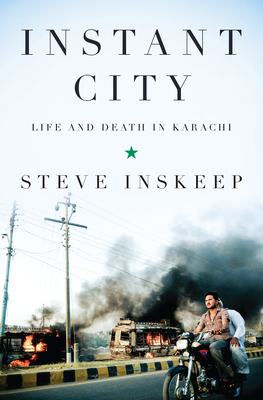
The Age of the "Instant City" is at an end. The subtitle of Steve Inskeep's new book is "Life and Death in Karachi". The Pakistani city serves as a case study for the urban boom in the wake of World War II. You'll learn as much about urban planning as you will Pakistan. The problem is migration, first political refugees (partition of India) and then economic refugees (rural to urban). The latter movement connects Karachi with the likes of Los Angeles, Houston, and Phoenix. All are, according to Inskeep, instant cities.
Inskeep defines instant cities in terms of population. The cities are growing at a much faster rate than the host nation state. I would define instant cities in terms of sprawl and the [seemingly] endless search for greenfields. Karachi's expansion in terms of area is as impressive as the spiraling population. There is more to manage than just religious differences.
Greenfields are "blank slates" best suited for the rationally planned community that was a hallmark of the era of logical positivism. Inskeep offers up Islamabad as a contrast to Karachi, which was anything but a blank slate.

more urban planning book reviews:

Wednesday, October 19, 2011

History of Letchworth Garden City

via First Garden City Heritage Museum

In 1898 a small book was published that was to have an effect all over the world. This book, entitled ‘Tomorrow A Peaceful path To Real Reform’, led to the building of two Garden Cities, inspired similar developments world-wide and set a precedent in new standards for urban environments that is still in use today.
The author was Ebenezer Howard, a shorthand writer and social reformer, who believed that he had the solution to the problems of the uncontrolled growth of towns and the migration of people from the countryside to the towns seeking jobs and homes.
By the late 19th century, towns and cities in this country - and in many of the industrialised nations - were overcrowded, polluted by factories and workshops and by the smoke from the coal fires of houses. Many people were living in slum housing and the quality of life for the poorest people, in particular, was almost indescribably bad.
In the countryside, life was often no better with many people out of work and living in houses that were as deficient as the worst houses found in the towns. Many agricultural workers and their families were forced to leave the country for the towns where they hoped to find jobs and houses. In fact, for many people life in the towns was just as difficult as the life they had left behind them.

read more

more about planning history:

Urban Planning and the British New Right

Railways, Urban Development and Town Planning in Britain, 1948–2008

Make No Little Plans: Daniel Burnham and the American City

Assessment of Garden City Planning Principles in the ACT

Jane Jacobs was the seer of the modern city

Jane Jacobs' classic book on urban living is 50 this year. Our current leaders would do well to read it

by

Who was the pre-eminent urban thinker of modern times? In his fascinating history of modern urban planning, Cities of Tomorrow, Sir Peter Hall devotes chapters to the likes of Ebenezer Howard (founder of the garden city movement); Patrick Geddes, the champion of self-governing city regions; and the great, utterly disastrous Le Corbusier.
But what of Jane Jacobs, whose most famous book, The Death and Life of Great American Cities, is 50 years old? Hall accords the book only a few paragraphs – "one of those classic cases of the right message at the right time" – and its birthday is going almost completely unmarked in the UK (apart from an event at the RSA this week). But it must be a lead contender for best and most enduring work on urban planning of the last century. Howard's Garden Cities of Tomorrow and Le Corbusier's La Ville radieuse are period pieces. But Jacobs' masterwork still feels relevant.
The story is well known – a classic David and Goliath. Jacobs, a housewife, mother and part-time architectural journalist, had been drawn into the campaign to prevent New York's dictatorial planning boss Robert Moses – who had already ripped up swaths of the city – from driving a highway through her native Greenwich Village. She decided to write a book.


photo by pdxcityscape

similar posts:

Urban Nation: Australia's Planning Heritage

Urban Planning Theory Since 1945

Resources of the City: Towards a European Urban Environmental History

New Urbanism and Planning History: Back to the Future

Wednesday, October 12, 2011

Book Review: Cities for People


Danish architect Jan Gehl has become something of a living legend in the urban design field. Founding partner of Gehl Architects, he was a professor at the Royal Danish Academy of Fine Arts and has taught and lectured throughout the world. His most famous book to date is Life Between Buildings (1987). Cities for People is his latest book and a culmination of everything he knows about designing people friendly streets and cities. While Gehl has mainly worked in Scandinavia and England, he was instrumental in the transformation of Melbourne, Australia into a more pedestrian friendly city and over the past couple of years he completed his highest profile project yet, the pedestrianization of Times Square in New York. Apart from his day job, he is at present a consultant to NYC for all things urbanism. 

In many ways this book is a handbook for how to design people and bicycle friendly cities. Based on years of experience, especially from Copenhagen, Gehl provides numerous examples of good and bad urban typologies from the perspective of pedestrians. If you're looking for a general city design manual, look elsewhere. For many it isn't difficult to identify a street they do or don't like, but Gehl's examples show us why. Quite plainly he brings a lot of common sense to the urban debate. Among all the lecturing and pretentiousness of some architects like Rem Koolhaas, Gehl offers genuine suggestions for fixing the many genuine problems our cities face today. 

The book is divided into several sections each dealing with a different aspect of cities, such as "Senses and Scale" and "Developing cities". A separate review should really be written dependent on the reader's experience with urban design, as those already familiar with the subject can pick up a few good tips but much of it will already be common knowledge. Who should really read this book are those not entirely certain what makes an enjoyable city fit for people rather than cars.

read more


more book reviews:

Book - Event Cities 4 Concept and Form

The Language of Towns and Cities

Book Review: Spatial Decision Support for Urban and Environmental Planning: A Collection of Case Studies, Edited by Davide Geneletti and Alias Abdullah

Think Globally, Act Regionally: GIS and Data Visualization for Social Science and Public Policy Research

Saturday, October 8, 2011

Book - Event Cities 4 Concept and Form

via UrbanTick

Increasingly architecture is produced globally. Large offices are delivering projects for clients more than half way across the world making it a very international profession. It is however mainly a oneway relationship with western practices operating for Middle Eastern or Asian clients. This means that even though there are financial benefits and gains in prestige, there are cultural differences and difficulties.
This applies both to the design process and the design as such in a form sense. Architecture is widely acknowledged as a cultural product and therefore this practice could be seen as a sort of cultural export of both practice and product, resulting in quite some problematic entanglement for architecture practices interested in contextual based design processes.
So far this dilema has had little focus, with large practices actually denying its existence for the past ten years at least. However, things are changing and practices are searching for ways and means to conceptualise this problem in order to develop a response.  
Bernhard Tschumi puts in his new book, Event-Cities 4: Concept-Form, published by MIT Press in late 2010, such a concept forward and presents how he and his practice has developed a process tool to takle this dilemma. 

read more

more book reviews:

The Language of Towns and Cities

Urbanization, Urban India and Metropolitan Cities in India.

Book Review: Spatial Decision Support for Urban and Environmental Planning: A Collection of Case Studies, Edited by Davide Geneletti and Alias Abdullah

Can Designers Solve the Problem of Urban Wasteland?

Tuesday, October 4, 2011

The Language of Towns and Cities

by Dhiru Thadani


The final word on the language of urban planning and design. The Language of Towns and Cities is a landmark publication that clarifies the language by which we talk about urban planning and design. Everyday words such as “avenue,” “boulevard,” “park,” and “district,” as well as less commonly used words and terms such as “sustainability,” “carbon-neutral,” or “Bilbao Effect” are used with a great variety of meanings, causing confusion among citizens, city officials, and other decision-makers when trying to design viable neighborhoods, towns, and cities. This magnificent volume is the fruit of more than a decade of research and writing in an effort to ameliorate this situation. Abundantly illustrated with over 2,500 photographs, drawings, and charts, The Language of Towns and Cities is both a richly detailed glossary of more than seven hundred words and terms commonly used in architecture and urban planning, and a compendium of great visual interest. From “A” and “B” streets to Zero Lot and Zeitgeist, the book is at once comprehensive and accessible. An essential work for architects, urban planners, students of design, and all those interested in the future of towns and cities, this is destined to become a classic in its field.


more urban book reviews:

Urbanization, Urban India and Metropolitan Cities in India.

Book Review: Spatial Decision Support for Urban and Environmental Planning: A Collection of Case Studies, Edited by Davide Geneletti and Alias Abdullah

An experiment in urban planning

Book Review: Self Sufficient City Envisioning the habitat of the future

Monday, October 3, 2011

Urbanization, Urban India and Metropolitan Cities in India.

via The Free Library

The present book is an attempt to study the process of urban growth, urban development constraints, urban policies and strategies to produce an integrated rural-urban model of urban development in India. It is a collection of essays by the author, Dr. V. Nath, a geographer by training, a practicising development economist, policy maker and analyst, who had written these essays over a period of about 45 years during his diverse job and life experiences in India and abroad. The essays provide the reader a comprehensive understanding of the urban development trends, processes, problems, scenarios and strategies for a balanced rural-urban growth. Since these essays are written by an expert, they provide an added value of giving an incisive and critical account of 50 years of urban development and metropolitan planning in India.
The book is divided into two sections. The first section deals with urban development and urban process in India. It contains 7 chapters (chapters 1-7). In this section the author has discussed the principle processes of urban development, looked into newer concepts of urban growth and suggested new approaches like an integrated growth concept of rural and urban areas with corridor development approach and integrated urban fringe development to achieve a balanced state of urban development in Indian cities. The second section deals with metropolitan India and contains 11 chapters (Chapters 8-18). In this section the author has raised specific problem-oriented issues like poverty, housing shortages and infrastructure inadequacies experienced by our few major metropolitan cities like Delhi, Mumbai, Kolkota and Chennai. The author also highlights a few ideal city models such as that of Bangalore, which needs to be replicated in order to achieve the same level of urbanization and efficiency. Regional planning and Master Plan for large metro cities is also suggested for integrated development of rural and urban areas.


New Delhi, photo by wili_hybrid
Delhi, photo by Carol Mitchell

more about India:

URBAN TRANSPORT IN INDIAN CITIES

GIS based Earthquake Risk-Vulnerability Analysis and Post-quake Relief Planning

Design Lessons From India's Poorest Neighborhoods

Urban Transport in Bangalore - The Worsening Crisis

Saturday, March 26, 2011

Book Review: Spatial Decision Support for Urban and Environmental Planning: A Collection of Case Studies, Edited by Davide Geneletti and Alias Abdullah

by Christopher Pettit

This is the first publication by Geneletti and Abdullah which brings together a concise selection of case studies of spatial decision support tools and applications. The array of tools and techniques in this edited collection of case studies includes a number of spatial planning and decision support systems that have been applied in a range of contexts from Europe, South East Asia and Latin America.
The book begins with an introduction of spatial decision support tools for urban and environmental planning by Klosterman. This sets the scene highlighting the important role information technology and spatial models play in supporting planning-based activities. The introduction provides a good segue into the first chapter by Sharifi and Zucca who introduce the reader to the concept of integrated planning and decision support systems where a comprehensive conceptual framework for planning and decision making is illustrated. The authors then describe the use of the Spatial Multi-Criteria Evaluation (SMCE) module within the Integrated Land and Water Information System (ILWIS) to undertake a selection of suitable sites and designs for a new park in northern Italy.


more urban planning book reviews:

To walk the path of Jane Jacobs – review of What We See, Advancing the Observations of Jane Jacobs

Urbanization, Urban India and Metropolitan Cities in India

Think Globally, Act Regionally: GIS and Data Visualization for Social Science and Public Policy Research

An experiment in urban planning

by A. SRIVATHSAN

Urban utopias took new avatar in Paolo Soleri's Arcosanti where architecture and environmentalism hit new collaboration. Auroville near Puducherry is one such utopian vision conceived partly as an ashram retreat and partly like a rationally organised urban precinct. This book is a documentation of the urban development and architecture witnessed within Auroville since 1964.
Mirra Alfassa, popularly known as the Mother visualised Auroville as an urban experiment to "undertake the work of evolution of consciousness." She commissioned the French architect Roger Anger to give form to her vision. Anger came with a spiral plan that resembled a galaxy with the Matri-mandir at its centre. The entire city was divided into industrial, cultural, residential and international zones with a green belt encircling it. The town was designed for a population of 50,000. The book discusses the features of urban planning and architectural accomplishments in three sections. The first section briefly documents the important stages of Auroville's urban development. It reproduces some of the archival images, sketches and notes that illuminate the ideas leading to its conception. In the second part, the details of the plan, the various zones and important buildings within them are listed and described. The last section profiles the various architects who are part of Auroville and gives brief description of their important works and views. 


more urban planning book reviews:

City Comforts – How to Build an Urban Village – Book Review

Léon Krier discusses The Architecture of Community

Urbanization, Urban India and Metropolitan Cities in India

Book review: Urban Transit: Operations, Planning and Economics

by George M. Smerk

Urban Transit: Operations, Planning and Economics, by Vukan R. Vuchic. John Wiley & Sons, Inc., 10475 Crosspoint Boulevard, Indianapolis, Indiana 46256 (order location). 2005. Pp.644. ISBN 0-471-63265-1. Hardcover. $120.00.
This book is the completion of a trilogy by Vukan Vuchic. The first book, Urban Public Transportation Systems and Technology, presented the reader with definitions and classification of the means of providing urban mass transportation. The second work, Transportation for Livable Cities, provides an excellent exposition of why transportation should be viewed by policy makers as a key means for making urban life a quality and humane experience, rather than as a function per se, judged without regard for its impact on the economic and social viability of urban communities. The third work, the object of this review, provides comprehensive coverage of the resources, analytical techniques, modes of urban transit, and practices needed to enable the supply of efficient, effective public transportation in ways that elevate urban livability and commercial vitality to levels beyond those attainable when transit is relegated to a subordinate or insignificant role.
Urban Transit consists of twelve chapters, divided into three sections: Transit System Operations and Networks; Transit Agency Operations, Economics, and Organization; and Transit System Planning. Together, they cover the full range of subject matter involved in, and essential for, effective planning, operation, and financing of transit systems. 


more urban planning book reviews:

Greening Cities, Growing Communities

Resources of the City: Towards a European Urban Environmental History

The City Beautiful Movement by William H. Wilson